April is Sexual Assault Awareness Month (SAAM). At Sierra Community House, this month is always a chance to slow down and have real conversations about prevention, support, and what it actually looks like to walk alongside survivors in our community. Awareness matters, but so does understanding the people and systems that show up when someone reaches out for help.
One of those people is a SART nurse.
SART stands for Sexual Assault Response Team. A SART nurse, often called a Sexual Assault Nurse Examiner (SANE), is a specially trained registered nurse who provides medical care after a sexual assault and, if a survivor chooses, conducts a forensic exam. Their role is both clinical and deeply human. They explain options. They move at the survivor's pace. They carefully document injuries and collect evidence. And they do it all through a trauma-informed lens, recognizing that the exam room can feel overwhelming after an already traumatic experience.
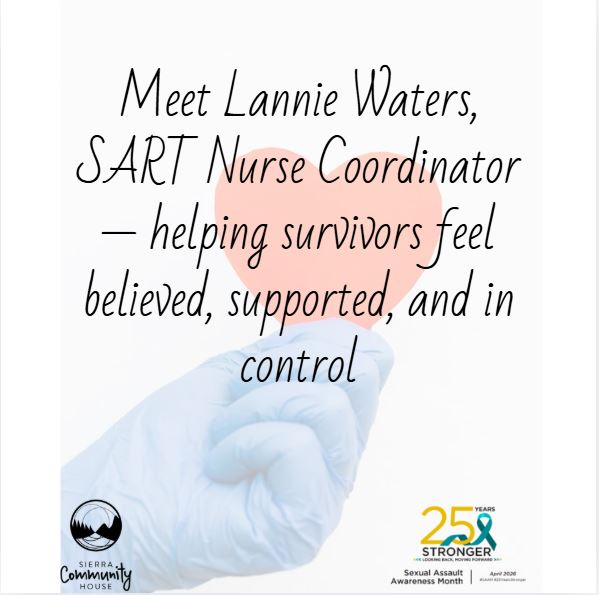
This year, we're grateful to sit down with Lannie Waters, BSN, RN, SANE-A/SANE-P (board-certified in both adult and pediatric sexual assault nursing), SART Nurse Coordinator with the Placer County District Attorney's Office. Lannie works closely with survivors as well as advocates, law enforcement, and prosecutors, helping ensure care is compassionate and coordinated.
Can you please tell us a little about your job and what led you to this important work?
I'm the Sexual Assault Response Team Nurse Coordinator for Placer County. I am also an active forensic nurse. In my role, I not only provide specialized care to survivors of sexual assault and IPV strangulation but also coordinate our response team to ensure patients receive efficient support from medical, advocacy, and law enforcement partners. Prior to becoming a SART nurse, I worked as an ICU nurse for 20 years. One experience that profoundly shaped my path was receiving an 18-year-old patient from the ER who had been sex trafficked. That moment made me realize I wanted to be part of work that brings care, compassion, and justice to patients during some of the most vulnerable times in their lives.
What does a SART nurse actually do?
SART nurses provide medical care after a sexual assault. If the patient consents, they will perform a forensic evidentiary exam where they assess and document injuries, collect evidence, and offer medications to prevent pregnancy or sexually transmitted infections. In my coordinator role, I also manage team logistics, training, and ensure collaboration between hospital staff, advocates, and law enforcement. Above all, we focus on supporting the survivor and empowering them to make informed choices.
What can someone expect if they come in for a forensic exam?
They can expect a private and supportive environment. We start by talking — reviewing medical history and what they feel comfortable sharing about the assault. If the patient consents, we conduct a head-to-toe exam and collect evidence, step by step, at their pace. Always meeting them where they are. We also provide medications, discuss follow-up care, and connect them with advocacy resources. The patient remains in control the entire time — they can pause, skip, or stop the exam whenever they want.
Do you have to report to law enforcement to receive care?
No, reporting to law enforcement is completely optional. Patients can receive medical care and a forensic exam without making a report. Evidence can also be collected and tested, and survivors have the right not to test their kit. This ensures that survivors are given time to decide what they want to do.
How do you make the exam process feel as safe and supportive as possible?
It starts with giving control back to the survivor and, most importantly, the attitude of believing them. I explain each step, ask permission, and move at their pace. Trauma-informed practices, emotional support, and having an advocate present if they want one all help. The goal is to create an environment where the survivor feels respected, believed, and supported — not rushed or judged in any way.
What are some common myths about sexual assault exams?
A big myth is that exams are always invasive and retraumatizing — they are done gently, with consent, and at the patient's pace. Another is that injuries must be visible; many survivors have no visible injuries, and that doesn't mean an assault didn't occur. It is normal to be normal. People also think they must decide immediately about pressing charges — you don't. Survivors can take time to consider their options.
How does the collaboration between medical teams, advocates, and the DA's office work?
It's truly a coordinated effort. Medical staff focus on patient care and documentation; advocates provide emotional support and resources; law enforcement handles investigations if the patient chooses; and the DA's office reviews cases for prosecution. My role as coordinator is to ensure all parts work smoothly together while keeping the survivor's needs at the center.
What do you wish our community better understood about supporting survivors?
I wish people understood how powerful it is to simply listen and believe survivors. Healing looks different for everyone, and there's no "right" way to respond to trauma. Not everyone cries, yells, or withdraws. Respecting their choices, giving them control, and connecting them with resources can make a profound difference in their recovery.
Thank you, Lannie, for the important work you do every day and for helping our community better understand how survivors are supported. If you or someone you know has experienced sexual assault, Sierra Community House's confidential advocacy team is here to help — reach out to us anytime.
Recent News