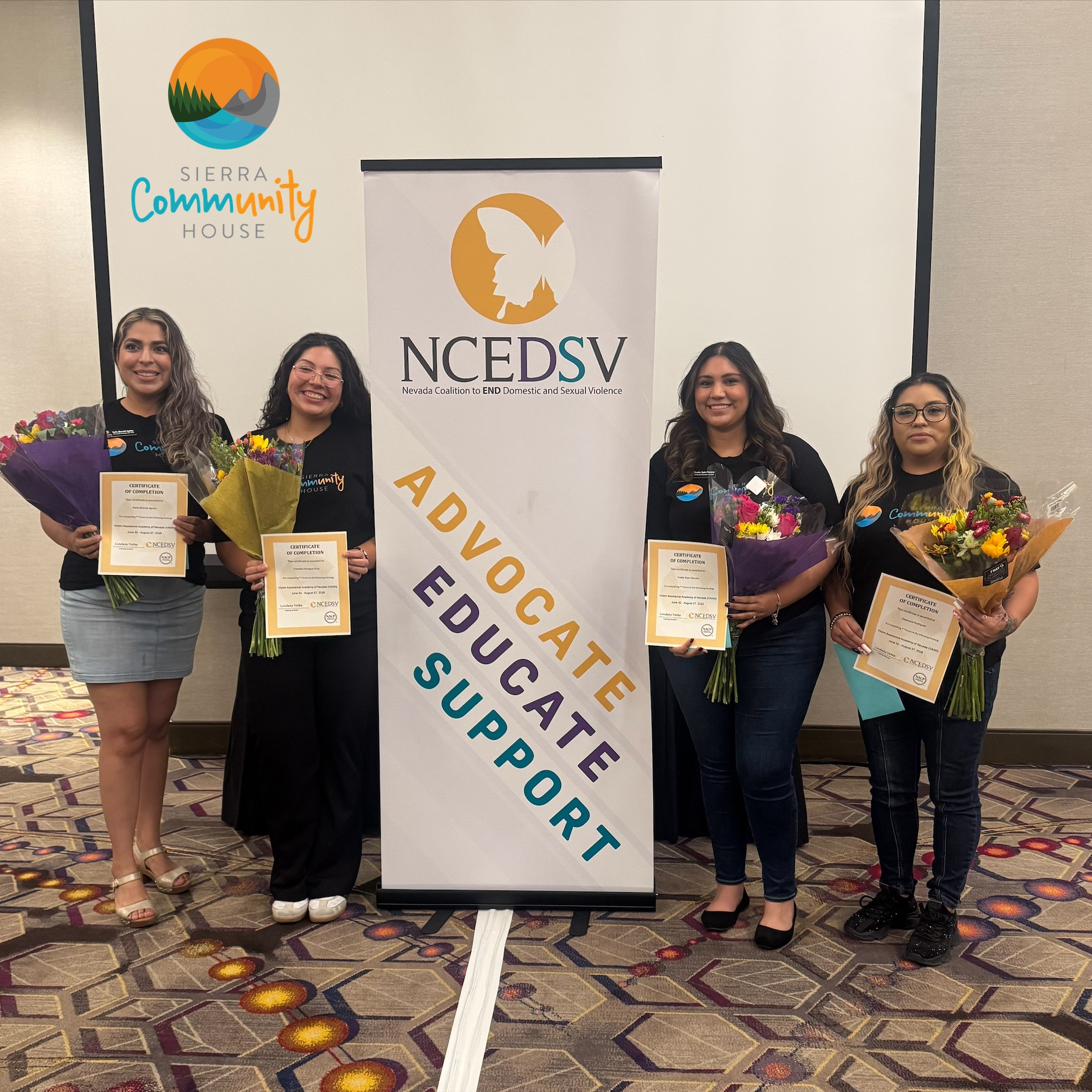
Last month, four members of the Sierra Community House team stood in a ballroom in Las Vegas and received something they’d spent three months earning: certificates of completion from the Victim Assistance Academy of Nevada.
Yvette Soto Herrera, Stephanie Rodriguez, Karla Marcial Aguilar, and Daniella Paniagua-Ruiz spent June through August in the Academy, a statewide training program run by the Nevada Coalition to End Domestic and Sexual Violence. The curriculum covered trauma-informed care, crisis intervention, cultural competency, human trafficking, safety planning, and navigating the criminal justice system, among other topics. Sessions ran weekly, mostly virtual, with a cohort of advocates from across the state who showed up together week after week to build a shared foundation for this work.
The closing ceremony, held September 18th in Las Vegas, was more than a formality. It was a chance for the whole cohort to gather in person for the first time, share a meal, and mark the end of a demanding season of learning.
We asked our team what the experience was actually like.
Why they signed up
- Yvette, Bilingual Legal Advocate: “This was about expanding my knowledge of crisis intervention resources and strengthening the services I provide across the Nevada-California border. Every piece of information and every connection can be useful when supporting someone in need.”
- Daniella, Bilingual Immigration Specialist: “I wanted to expand my understanding of what it means to be trauma informed. Since we also work with clients from Nevada, I wanted to understand what Nevada provides for victim-survivors and how Nevada’s laws work.”
- Stephanie, Bilingual Crisis Advocate: “My work has shown me how much courage it can take for someone to reach out for help. This training was a chance to deepen my understanding of domestic and sexual violence and take what I learn back to SCH, so I can keep becoming the kind of advocate who helps people feel less alone in their hardest moments.”
- Karla, Legal Advocate: “I feel privileged to work for an organization that supports survivors in more than one state, and I feel a responsibility to stay current on the resources and trainings available in both. That knowledge helps me provide trauma-informed support that fits each person’s needs.”
What stuck with them
- Yvette: “One statement that stayed with me was, ‘Anyone can abuse, and anyone can be abused.’ There are no exceptions when it comes to domestic violence and sexual assault. Talking with other advocates about burnout, empathy, and the support we provide also reminded me that we aren’t alone in this work, and that small steps add up to something real.”
- Daniella: “The way Nevada’s legislature works stood out to me, especially the victim-survivor bill of rights passed in 1983. Working with advocates across the state also opened my eyes to how rural Nevada is. Advocates in smaller communities sometimes have to jump through hoops just to provide adequate services.”
- Stephanie: “Supporting survivors in detention settings impacted me deeply. I hadn’t fully considered how those circumstances affect a person’s ability to feel safe or ask for help. It reinforced that advocacy means showing up for people even when systems create barriers. Learning alongside advocates from across Nevada reminded me that this work doesn’t happen in isolation.”
- Karla: “Learning about the Children’s Domestic Violence Wheel was especially eye-opening. It shows how exposure to violence can affect children well into adulthood. It reinforced how important it is to connect children with resources like therapy, even when they don’t show signs of trauma right away.”
Bringing it back to SCH
- Yvette: “Much of the training connects directly to our day-to-day work. One example was the revision of the Power and Control Wheel, which reinforced that abuse isn’t limited to romantic relationships and can take many forms. It’s a reminder to look at circumstances from different angles while keeping survivors’ safety at the center.”
- Daniella: “The training clarified how Nevada’s justice system works and what a victim-survivor goes through navigating it. It also helped me build skills to be more trauma-informed, and to understand how someone’s past shapes how they interact with services.”
- Stephanie: “I see every day how important it is to support the whole person, not just the immediate crisis. Language, culture, housing, and access to resources all play a role in someone’s path forward. This training strengthens my ability to meet people where they are.”
- Karla: “The training helped me better understand the barriers and trauma people may have faced in their lives. It also reminds me to keep learning from each person I work with, because survivors are the experts in their own lives.”
Why this matters for DVAM
October is Domestic Violence Awareness Month, and this training couldn’t be more timely.
- Daniella: “Not every survivor’s story is the same. The training was good at explaining how someone might react based on what they’ve gone through, and the importance of staying flexible and patient.”
- Yvette: “Love shouldn’t hurt, and peace starts at home. Prioritizing your safety and breaking the cycle of abuse matters just as much as meeting your everyday needs. Sierra Community House’s mission is about strengthening the whole person and the whole community, and continuing our education helps us provide more informed, meaningful support.”
- Stephanie: “When we support one survivor with compassion and understanding, we’re also helping strengthen the families and community around them. That’s how this training connects to SCH’s broader mission, building a community where people feel safe, valued, and empowered to create a different future.”
- Karla: “The training deepened my understanding of how to build plans that help survivors feel in control of their lives. My job is to share their options, support their decisions, and walk with them through the legal process. Supporting survivors’ independence and their right to make informed choices is at the heart of what SCH does.”
What’s next
- Yvette: “The certificate represents the hard work we put into this training, and it’s a reminder that we can keep accomplishing new things and expanding our knowledge.”
- Daniella: “Finishing this training reminds me of the important work our agency provides. I’d definitely recommend it to any colleague thinking about it.”
- Stephanie: “This certificate reminds me that advocacy isn’t about having all the answers. It’s about listening, continuing to learn, and standing beside people when they feel alone.”
- Karla: “This certificate reinforces my commitment to keeping up as laws and resources change. I need to understand how those changes affect our community, especially survivors and their ability to thrive.”
As we head into October, we’re proud to have four newly credentialed advocates on our team, ready to bring what they learned directly into the work we do every day for our community. Watch for more from SCH throughout Domestic Violence Awareness Month.
Recent News