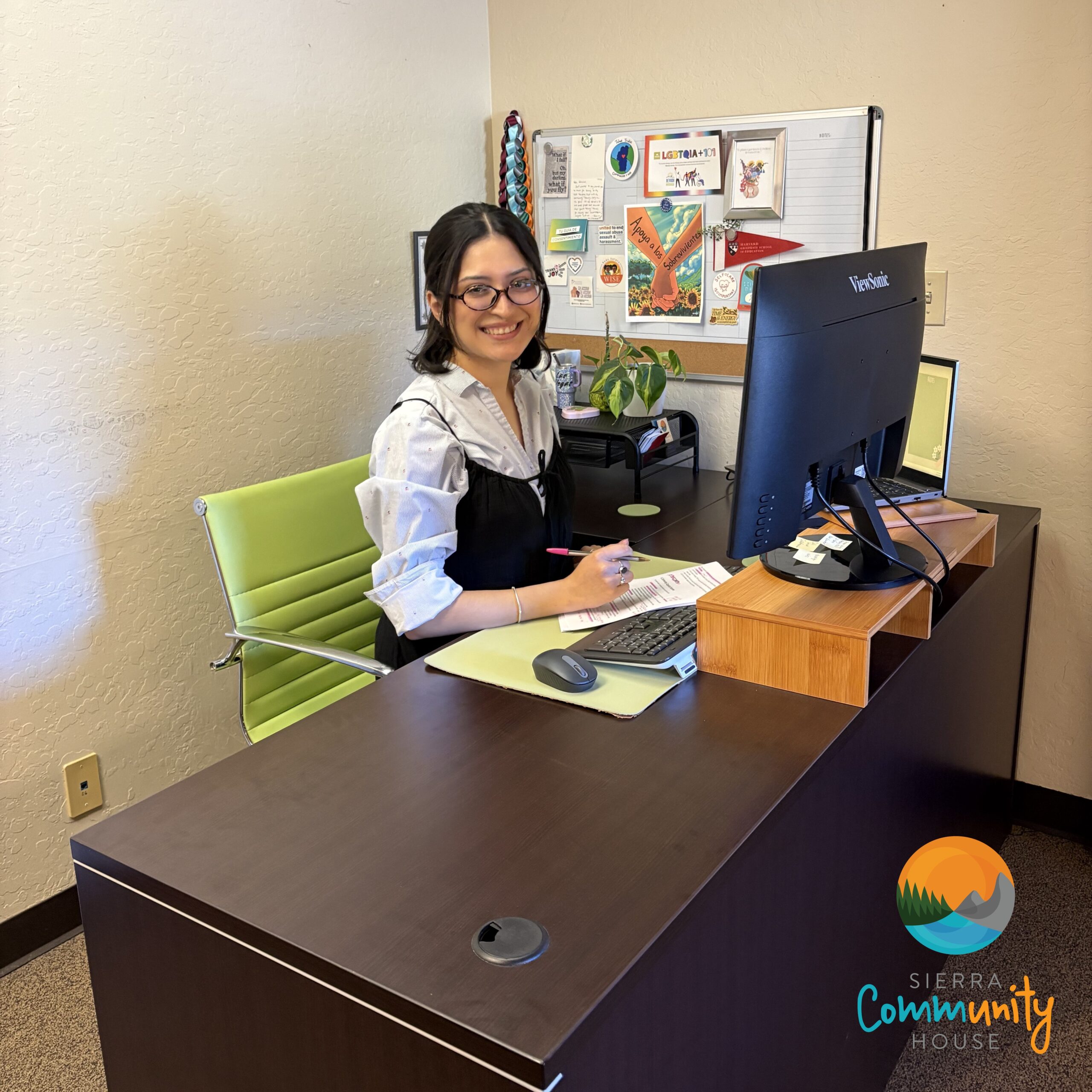
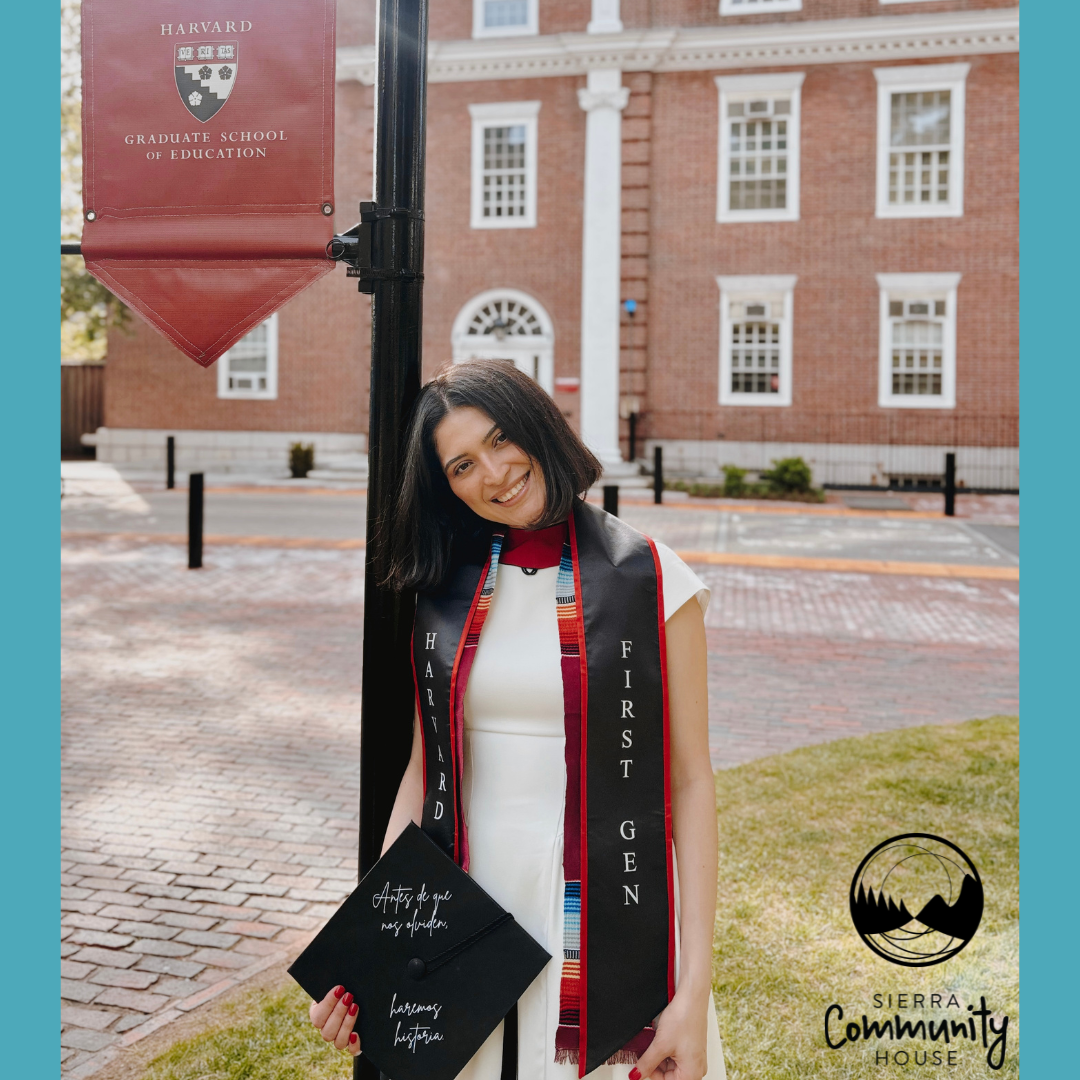
We sat down with Denisse to talk about her journey from Sierra College to UC Davis to Harvard, and what she hopes to bring back to this community.
Q: You grew up in Paredones, Mexico, and were the first in your family to attend college. How did that experience shape the way you show up for clients and community members at Sierra Community House?
When my family moved to Truckee, we went to Sierra Community House (formerly the Truckee Family Resource Center) for assistance. I sat with my mom at the very same office where I work today. Working at Sierra Community House truly feels like a full-circle moment, and I am deeply grateful I get to give back to the community. My experiences as an immigrant and first-gen professional bring compassion and empathy to my work. I understand how hard it is to navigate unknown systems (education, housing, health, etc.), so I always want to create a safe and welcoming space.
Q: Your honors thesis at UC Davis centered on immigrant students navigating higher education. What did you hear in those interviews that stuck with you — and how does it connect to the housing and resource barriers you see in your work here?
One of the things that stuck with me from those interviews is the lack of support available to immigrant parents and their children to navigate and better understand the education system. The challenges that my interviewees shared with me also apply to housing and other systems we help community members navigate, such as language barriers and financial hardships. However, I also see the same drive and motivation. Immigrant communities believe in the value of education and hard work, and they bring incredible resilience, experiences, and skills.
Q: You went from earning associate's degrees at Sierra College to graduating summa cum laude from UC Davis to enrolling at Harvard. What kept you pushing forward when the path felt impossible?
My desire to make my family's sacrifices worth it, and the conviction to make a meaningful contribution through my education. I also kept going because of the support of my mentors, especially at Sierra College, who believed in my abilities even when I doubted myself.
Q: Sierra Community House's housing work is deeply tied to the region's affordability crisis. How did working as a housing coordinator here inform the questions you want to explore in your graduate research?
Seeing the need for more underrepresented families in housing-related decisions has further solidified my commitment to work with underrepresented student populations. Additionally, providing direct services and witnessing the journey of vulnerable community members has trained me to bring an intersectionality lens to my work and recognize diverse identities (low-income, immigrant, with disabilities, etc.). It has also helped me better understand my privileges and my positionality as both a service provider and a researcher.
Q: Your focus at Harvard is on the intersection of migration and education. Why does that intersection matter so much, and what does it look like up close in a community like North Lake Tahoe and Truckee?
Education is often one of the main reasons families migrate: parents move to give their kids better educational opportunities, and their children learn to navigate institutions that were not built for them. This work matters because immigrant communities, particularly communities of color, are often seen and served through a deficit lens. But immigrant communities bring resilience, unique perspectives, and strengths that need to be recognized. Immigrant-origin students are a significant portion of the student body in North-Tahoe Truckee, and this work matters because we need to name the barriers they face, but also the strengths and cultural richness they bring with them, if we truly want to help them thrive.
Q: Scholarship support from TTCF made Harvard financially possible for you. What would you want donors and community members to understand about what that kind of investment means for someone in your shoes?
Something I always want to highlight is that these scholarships are not an individual award. I am driven and fueled by my community, I carry the dreams of my ancestors and the hopes for future generations. In my thank you letter to the Workforce Scholarship donors, I told them their generosity is not only towards me, but towards the younger versions of myself, my grandparents, my parents, my sisters, and other women and girls who may relate to my experiences because they are also immigrant, first-gen, and from low-income families. This is a sentiment I have heard other first-gen students express too. It is worth investing in us because when we get there, we help others get there too.
Q: You've said you want your research to create more pathways for immigrant students to succeed academically. What does a more equitable education system actually look like in practice — especially in rural mountain communities?
There are so many ways in which we can improve the education system, but the focus of my work is to empower youth through participatory action research. In a more equitable education system, youth feel empowered to name systems of oppressions and imagine a just future.
Q: You plan to return to Tahoe-Truckee after graduating. What do you hope to bring back, and what role do you see yourself playing here in five to ten years?
At HGSE, I engaged in work applying concepts such as critical hope, which speaks to the need for educators and adults to help youth understand the historical context and marginalization that underrepresented students experience, along with the necessary resources to cope with this reality. It is only from this place of knowing that they can imagine and work together towards a better future. As educators, researchers, community-based organizations, and service providers, we all need to work together to embody critical hope and empower youth. I aspire to be part of those community partnerships.
Q: What would you say to a young person in this community — maybe an immigrant, maybe a first-generation student — who feels like the kind of path you've taken isn't available to them?
I see you, and I am rooting for you. Being the first in your family to pursue higher education is challenging, and learning to navigate a new education system can be scary and overwhelming, but it builds incredible resilience and strength. Lean on your community: your family, mentors, teachers, friends, and peers. I am here thanks to all the people who have believed in me, and thanks to the generosity of our community for providing scholarships for students like us. You are paving the way, and it will all be worth it.
Recent News